A folly is rarely just a building. It is a punchline in stone, a tower with no purpose, a temple that leads nowhere. That is precisely what makes them such rewarding subjects — and what makes them so easy to photograph badly. Get it wrong and you end up with a grey lump against a grey sky. Get it right and the same structure looks like something out of a dream. The difference is almost never the camera. It is timing, light and a bit of time spent working out what the folly is actually doing in its landscape.
Scout First, Camera Second
If you can, visit without a camera before you visit with one. Walk the site, note where the sun rises and sets relative to the main elevation, and look for the angles that show the folly at its most interesting. A tower might be dull head-on but magnificent in three-quarter view with a path leading in.
Useful things to check on a recce:
- Direction the main facade faces, so you know when it will be lit.
- Vantage points that include foreground interest — a gate, a ha-ha, a stand of trees.
- Where the crowds, cars and bins are, so you can frame them out.
- Access rules, opening times and any paths that are closed seasonally.
- How the ground behaves underfoot after rain.
Follies are often on private estates with public footpaths nearby. Check signs, stay on rights of way and never climb on the structure itself. Old masonry, rotten timbers and unstable stairs are genuine hazards, and many follies are listed buildings with legal protection. If a gate says no, it means no.
Work the Light
The best hours are usually the two either side of sunrise and sunset, when the sun sits low and rakes across the stone. Side light picks out texture — the grain of limestone, the pattern of brickwork, the shadow of a moulded cornice. Front light flattens everything; backlight can turn a folly into a silhouette, which is dramatic but only works if the shape is strong enough to carry it.
Overcast days are underrated. Soft, even light suits carved detail and lets you photograph inscriptions and grotesques without losing highlights, though the sky will be flat and grey, so include plenty of foreground or frame tight on the building. After rain, stone darkens and colours deepen, and wet paving can give you reflections.
Midday sun is hard work. Use it for graphic shadows across a wall, or shoot into the light and expose for the sky, shading the lens with your hand to control flare. A humble tip: check the building's orientation on a map before you go, and you will know whether morning or evening light will strike the side you want.
Seasons and Weather
Each season changes what a folly appears to be. Winter strips the trees and reveals shapes and proportions that summer hides, and low sun reaches into places it never touches in June. Bare branches also mean fewer distractions, though you will need to watch exposure when snow is on the ground — bright snow fools meters into underexposing the building.
Spring brings fresh growth and, in some wooded estates, bluebells and wild garlic. Treat these with care: keep to paths and never trample a colony for a shot. Autumn colour can make a plain tower sing, and fallen leaves give you foreground texture, though you may want to clear a few from a doorway for a tidier frame.
Summer gives long days and strong light, but dense foliage can swallow smaller structures entirely. Go early or late, and consider whether the folly is better photographed as a glimpse through leaves rather than a full portrait.
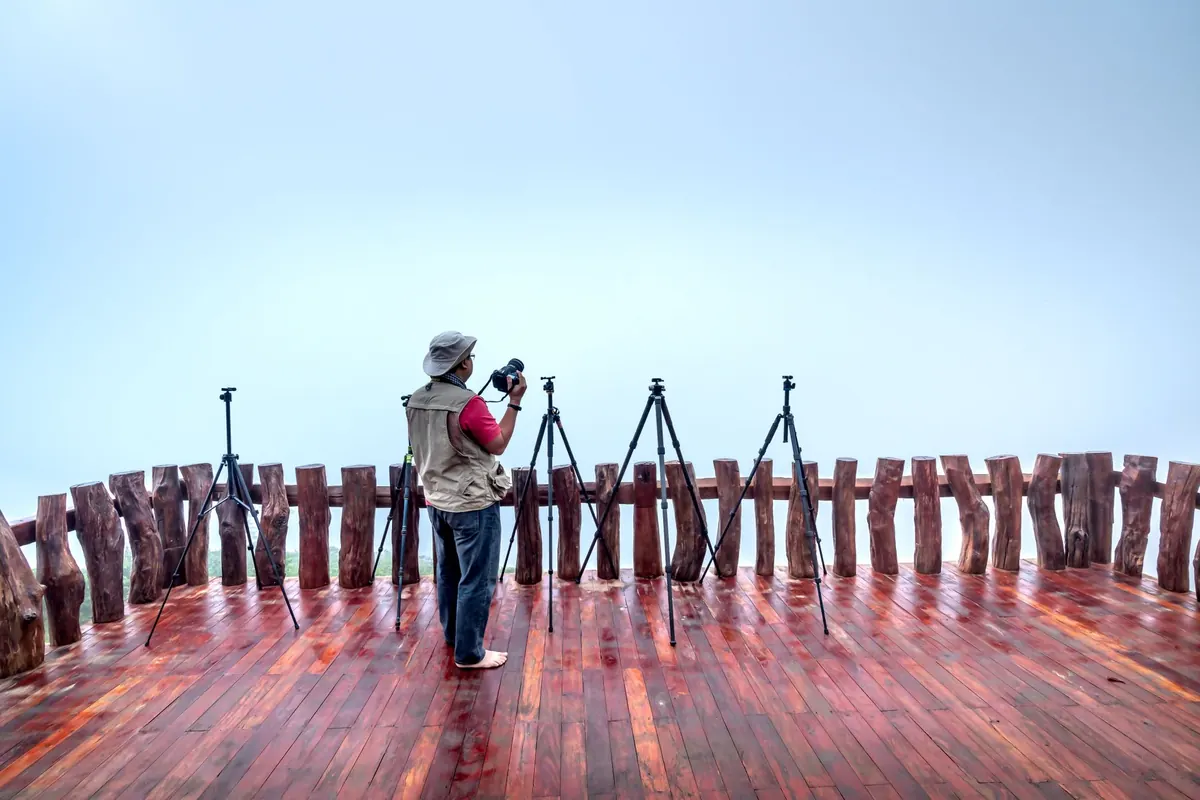
Weather is not the enemy. Rain adds atmosphere if you keep the lens dry and use a cloth and a cover. Mist and fog can be wonderful, isolating a tower in a grey void and hiding modern clutter behind it, but it burns off quickly, so arrive before dawn. Storm light — dark cloud with a bright break — is the most dramatic of all; just keep yourself and your equipment safe, and stay away from exposed ridges, tall structures and lone trees when lightning is around.
Composition With Character
Ask what the picture is about. Is it the folly, or the folly in its setting? Step back and the building becomes part of a wider view; move in and it becomes a study of detail. Both are valid, but mixing them without intent produces muddle.
Try framing through something — an arch, a gate, a gap in a hedge — to add depth and a sense of discovery. Look for leading lines: paths, walls, avenues of trees. Including a person, a bicycle or a bench gives scale, which matters enormously with follies, since their whole appeal is often sheer oddity of size. Keep the camera level; converging verticals can be deliberate, but accidental keystone distortion just looks sloppy. And remember to look behind you — the best angle is sometimes the one you walked past on the way in.
Kit and Settings Without Fuss
A tripod is the single most useful accessory, letting you use small apertures for front-to-back sharpness and slow shutter speeds in low light. A polarising filter cuts glare from wet stone and water and deepens a blue sky, though it does little on a dull day. A zoom covering roughly 24–70mm equivalent will handle most scenes, with something longer useful for compressing a folly against a distant hill.
Shoot RAW if you can, and check the histogram rather than the screen — stone highlights blow out quietly. For architecture, focus roughly a third of the way into the scene at f/8 or f/11 for even sharpness. Bracket exposures when the sky is bright, and use a remote release or the self-timer to avoid shake. Do not over-sharpen afterwards; stone and foliage quickly turn crunchy.
Details, Return Visits and Manners
Photograph the small things too: a carved keystone, a mossy step, an iron gate, an inscription half-erased by weather. These pictures often say more about a folly than a wide view, and they are easier to get right on a flat grey day.
Come back. A folly photographed in June and again in January will look like two different buildings, and returning in the same conditions will teach you faster than any tutorial. Note the light, the weather and the season alongside your files so you can plan a repeat.
A Last Word on Visiting Well
Follies are fragile, often isolated and frequently on private land. Park considerately, close gates, take litter home and keep drones away unless you have explicit permission — many estates ban them, and they spoil the quiet for everyone else. Do not move stones, prune branches or climb on walls for a better angle. With patience, decent light and a little respect, the strangest buildings in Britain will reward you with the strangest, and best, photographs you take all year.
Photo: Quang Nguyen Vinh / Pexels